
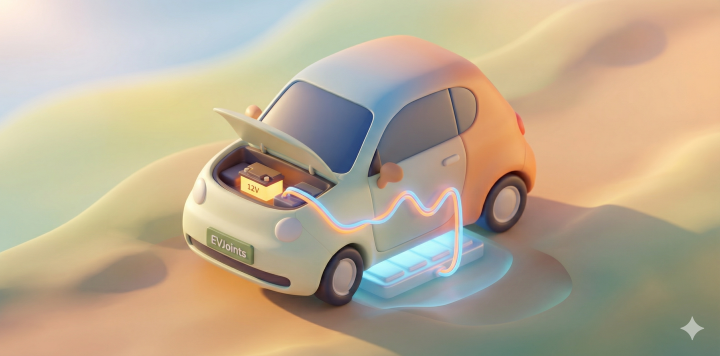
When most people think of an electric car, they picture one large battery pack placed under the floor. That is true — but it is only part of the story.
Every electric vehicle actually has two batteries:
- A high-voltage (HV) battery
- A low-voltage (LV) battery, usually 12V
Both serve completely different purposes, and your EV cannot function properly without either of them.
Think of it like a city.
The HV battery is the power plant that runs trains, factories, and major infrastructure.
The LV battery is the local power grid that keeps homes, traffic lights, shops, and communication systems running.
One delivers the power to move the car. The other keeps the entire system alive.
Together, they make the EV safe, reliable, and usable.
What Is the HV Battery?
The high-voltage (HV) battery is the main power source of the electric vehicle.

It typically operates between 200V and 800V, depending on the vehicle architecture, and is responsible for:
- Powering the electric motor that drives the wheels
- Supporting fast charging
- Running high-energy systems such as air conditioning and cabin heating
- Providing regenerative braking energy storage
This is the large lithium-ion battery pack most people associate with EVs. Want to understand which battery chemistry your EV uses? Read our guide on LFP vs Lithium-ion vs Sodium-ion batteries.
Depending on the model, it can range from 30 kWh to over 100 kWh.
In simple terms, this battery defines:
- Driving range
- Performance
- Charging speed
Without the HV battery, the car cannot move.
What Is the LV Battery?
The low-voltage (LV) battery, usually 12V, may be smaller in size, but it plays a critical role.

It powers all the electronics that make the car usable, including:
- Lights and indicators
- Wipers
- Infotainment and displays
- Power windows and door locks
- Sensors and control modules
- Safety systems such as airbags
Most importantly, it powers the systems that wake up the car.
Before the HV battery can send power to the motor, the vehicle’s control units need to boot up and activate the relays (contactors) that connect the main battery pack.
That initial startup process depends on the LV battery.
Many EVs still use a 12V lead-acid or AGM battery, similar to petrol and diesel cars.
However, newer models are gradually shifting to lithium-ion 12V batteries, which are lighter and last longer.
Why Not Use the HV Battery for Everything?

A common question is:
If the EV already has a huge battery, why not power everything directly from it?
There are three major reasons.
- Safety
High-voltage systems are dangerous to handle.
Running every small component on 400V or 800V would significantly increase risk and complexity.
Low-voltage systems are far safer for electronics and maintenance.
- Cost and Standardisation
The automotive ecosystem has been built around 12V architecture for decades.

Scan the barcode and download the EVJoints app to find 6,000 EV charging stations across various networks.

Click & download the EVJoints app to find 6,000 charging stations.


Using the same voltage allows manufacturers to reuse existing components, sensors, wiring systems, and modules, which reduces cost.
- Reliability
The LV system can continue supporting critical electronics even if the HV system shuts down.
This ensures that essential safety functions like:
- hazard lights
- airbags
- central locking
- warning displays
can still operate during faults or emergencies.
The two batteries are connected through a DC-DC converter, which steps the HV battery’s voltage down to 12V and keeps the LV battery charged. If you’re new to EV charging systems, here’s a quick guide on AC vs DC chargers and how they work.
Think of it as the EV equivalent of an alternator in a conventional car.
What Happens If the 12V Battery Fails?
This is where things often surprise EV owners.

Even if your main HV battery is fully charged, the car may still not start if the 12V battery is dead.
Why?
Because:
- the control systems cannot boot up
- the relays connecting the HV battery will not engage
- the vehicle cannot “wake up”
In simple terms, the car may appear completely dead even though the main battery still has plenty of charge.
The good news is that the fix is often simple:
- jump-start the 12V battery
- replace the battery if needed
Once the LV system is restored, the EV usually starts normally.
Early Signs of a Weak 12V Battery
Watch out for these warning signs:
- dim lights
- slow power windows
- sluggish door locks
- random warning messages
- repeated 12V battery alerts

Catching these early can help prevent unexpected no-start situations.
The Future of LV Batteries in EVs
Automakers are steadily improving this part of the system.

Some EVs now use:
- lithium-ion 12V batteries, which are lighter and longer-lasting
- 48V systems in certain premium and next-generation vehicles
However, the 12V setup is likely to remain the industry standard for many years because of:
- cost efficiency
- component compatibility
- proven reliability
Conclusion
An EV runs on two batteries, not one.
The HV battery powers the drive system and moves the car.
The LV battery powers the electronics, startup systems, and safety functions that make the vehicle usable.
One provides the muscle.
The other powers the brain and nervous system.
So the next time your EV doesn’t turn on, don’t just think about range — sometimes the smaller battery is doing the biggest job of all.


